
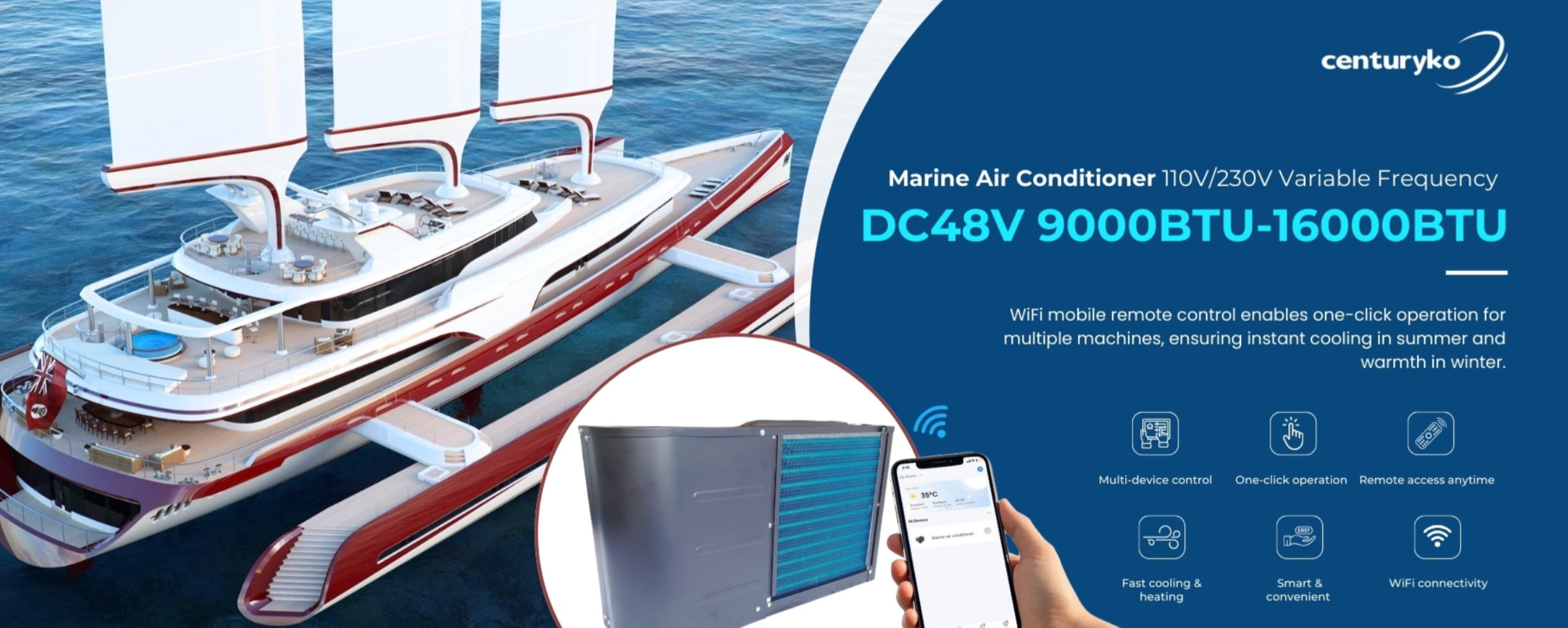
The problem: decarbonization targets that collide with onboard comfort
Commercial fleet managers face a clear mandate: reduce greenhouse gas emissions while keeping crew and cargo climate-controlled. This tension is acute on short-haul ferries, workboats and service fleets where auxiliary power makes a visible slice of fuel burn. A practical lever is HVAC electrification and load reduction, starting with properly specified 12,000 BTU units and efficient control schemes—think modern inverter-driven compressors and smarter ducting. For many operators, switching to a 48v marine air conditioner becomes the first step toward measurable gains, because it lowers engine idling and opens the door to battery-based microgrids.
Why traditional installations stall decarbonization
Older systems were sized by guesswork: oversized BTU capacity, poor insulation, and basic on/off controls. That brings excess cycling, low COP, and needless fuel for generators. The result is paradoxical—huge air handlers that increase auxiliary load. Fleet managers in ports like Rotterdam and shipping corridors that follow IMO 2020 rules have started to note that small changes to HVAC design yield outsized emissions reductions. The familiar culprits are inefficient condensers, fixed-speed compressors, and single-point power feeds.
How optimized 12,000 BTU systems change the math
Right-sizing a 12,000 BTU unit to the cabin footprint, using inverter-driven compressors, and improving condenser placement trims energy demand. Adding variable-speed fans and improved insulation raises effective COP and cuts runtime. Operators replacing legacy units with DC-native designs often see reduced idling and simpler integration with battery banks. Integrating a 48v dc marine air conditioner lets vessels run HVAC off stored energy during port stays and reduces generator hours at sea.
Practical steps fleets should take
Start with a short energy audit: log runtime, measure auxiliary kilowatts, and map thermal losses. Then apply three sequential fixes: correct BTU sizing, swap fixed-speed compressors for inverter models, and reposition condensers for better airflow. Install basic programmable controls to avoid unnecessary night cooling. Small civil works—improved seals and targeted insulation—often pay back faster than replacing big machinery. And track shipboard metrics: runtime hours, average compressor draw, and daily generator run-time.
Common mistakes and better alternatives
Teams often replace like-for-like, assuming bigger BTU equals better comfort. That’s not true. Oversizing increases cycles and reduces efficiency. Another misstep is ignoring control strategy—manual thermostats lead to human-driven waste. Instead, choose modular DC units that allow staged cooling and integrate with battery management. Consider hybrid approaches: a compact 12,000 BTU inverter system for habitable spaces plus targeted ventilation for equipment rooms. —It’s a small shift but it frees up fuel budget quickly.
Case anchor and lessons from the field
After IMO 2020 tightened emissions focus, several short-sea operators re-evaluated auxiliary loads in Europe’s ferry corridors. Practical retrofits—better condensers, inverter compressors, and DC-compatible controllers—reduced generator hours on turnaround days. This real-world anchor shows improvements come from system design and operational change, not only component swaps. Fleet managers can replicate the same steps in harsh climates and busy ports; the approach scales.
Evaluation metrics and golden rules
Three critical metrics let you judge choices quickly: net auxiliary kW saved per day, compressor runtime reduction percentage, and system COP under typical load. Golden rules: pick inverter-driven 12,000 BTU units matched to cabin heat gain, prioritize condenser placement for unobstructed airflow, and ensure DC compatibility when batteries are present. These metrics keep decisions measurable and make ROI transparent.
Fleet teams that act on these rules cut emissions, reduce fuel spend, and improve comfort for crews—real outcomes that matter on a busy deck. ZhuoliMarine. –