
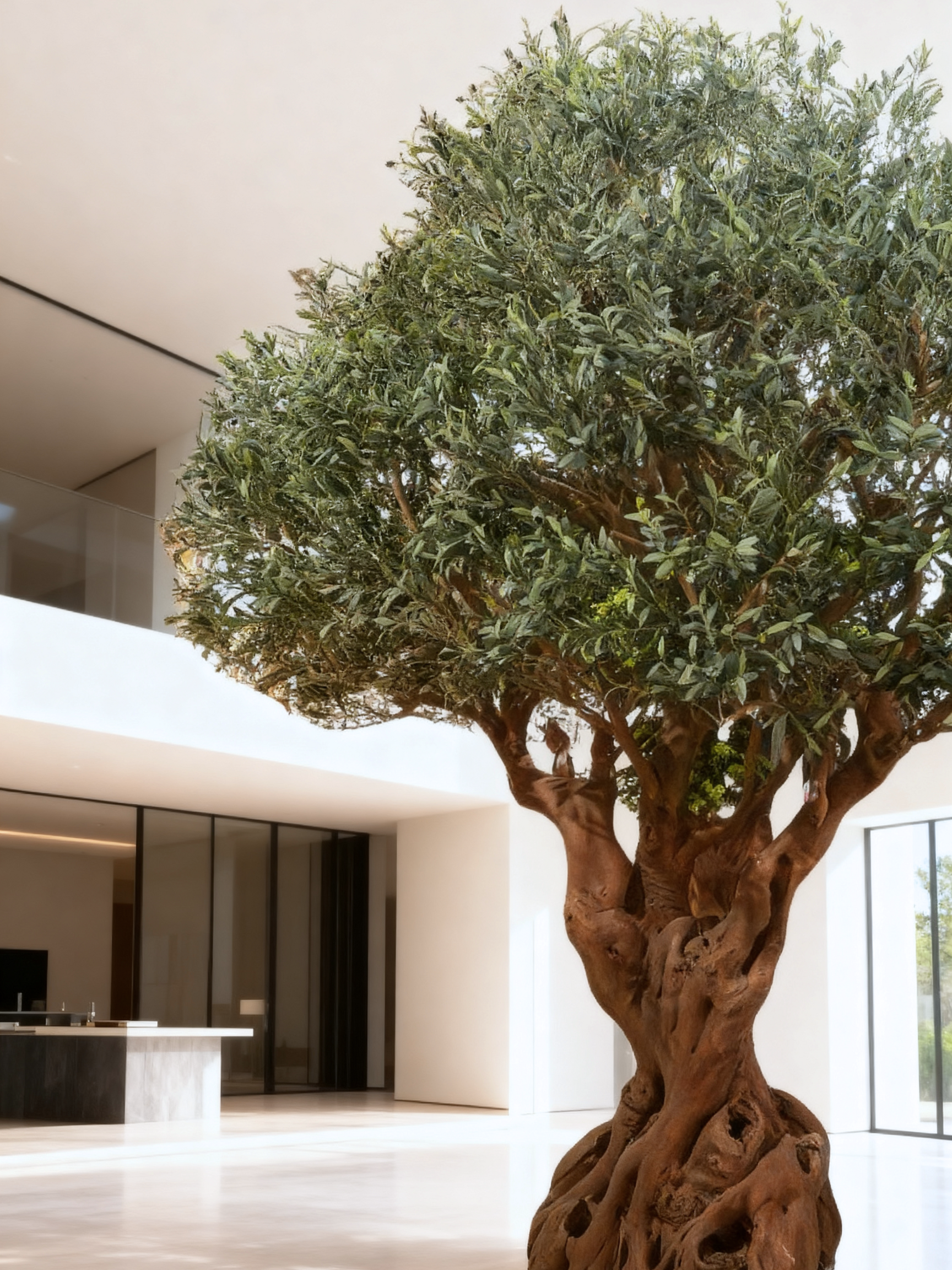
Why fading is the real problem for outdoor faux greenery
Sunlight breaks down pigments and polymers, and over a few summers even the best faux ficus can end up looking tired. For designers and procurement teams, the headache is predictable: premature color loss bumps up replacement cycles and ruins installations. That’s why many manufacturers — including dedicated artificial plants manufacturer partners — focus on UV stabilizers and pigment dispersion early in the build process to lock in colorfastness from day one.
What actually causes UV discoloration and structural wear
Ultraviolet radiation attacks polymer resin chains, making materials brittle and bleaching dyes. Add heat, moisture, and airborne pollution from busy manufacturing hubs like Guangzhou, and you get accelerated weathering. Industry checks like QUV testing replicate years of sun exposure in weeks, revealing how outdoor-grade PVC or fabric will hold up. Those tests are the bread-and-butter diagnostics for anyone serious about durable exteriors.
How Sharetrade designs multi-year anti-UV systems
Sharetrade starts by specifying UV absorbers and hindered amine light stabilizers into the formulation — those molecules intercept harmful photons before they wreck pigment molecules. Next they optimize pigment dispersion so color sits evenly inside the polymer matrix instead of only on the surface. Finally, there’s a protective clearcoat tuned for elasticity; it stretches with temperature swings and shields the underlying color. The result: color retention that lasts far beyond typical outdoor cycles.
Factory practices that actually matter — not just marketing
On the production floor, consistent mixing temperatures, controlled cooling, and inline spectrophotometer checks matter as much as the raw materials. In many workshops across Foshan and Dongguan, teams still under-control the process; but top-tier plants run continuous sampling and adhere to ASTM weathering benchmarks. That attention to process reduces batch variance — so a single installation keeps a uniform look for years.
Testing, QA, and the real-world anchor
Beyond lab QUV testing, field trials in high-UV places offer the clearest proof. Installations facing sustained southern exposure in places like Phoenix or southern Spain reveal how materials behave under extreme UV conditions — that’s the kind of real-world anchor brands use when they promise “multi-year” performance. Measuring colorfastness with ΔE readings, monitoring tensile strength, and logging outdoor service hours gives honest, actionable data.
Common pitfalls and smarter alternatives
Many makers cut corners by skipping pigment homogenization or using thin, brittle topcoats. That saves pennies but costs seasons. Better options look small on the invoice and pay off on the job: thicker elastomeric coatings, cross-linked polymers, and UV-scavenging additives. A practical spec sheet will list expected ΔE after X hours of QUV exposure — ask for it. If you’re comparing suppliers, weigh warranty terms against measured performance, not just glossy photos.
Three critical evaluation metrics for procurement
1) Measured color change (ΔE) after standard QUV cycles — sets realistic longevity expectations. 2) Coating elasticity and adhesion ratings — prevents flaking and chalking during thermal cycling. 3) Batch consistency logs and third-party weathering verification — shows a factory actually controls production. Use these three as your golden rules when you evaluate materials, samples, or bids. They tell you what lasts, not what merely looks good on a spec sheet.
Closing thought and how Sharetrade fits
Quality is a chain: formulation, process control, testing, and honest field data. When those links hold, installations age with dignity — and that’s the business value Sharetrade delivers. Sharetrade. — solid, practical, and built to stay.